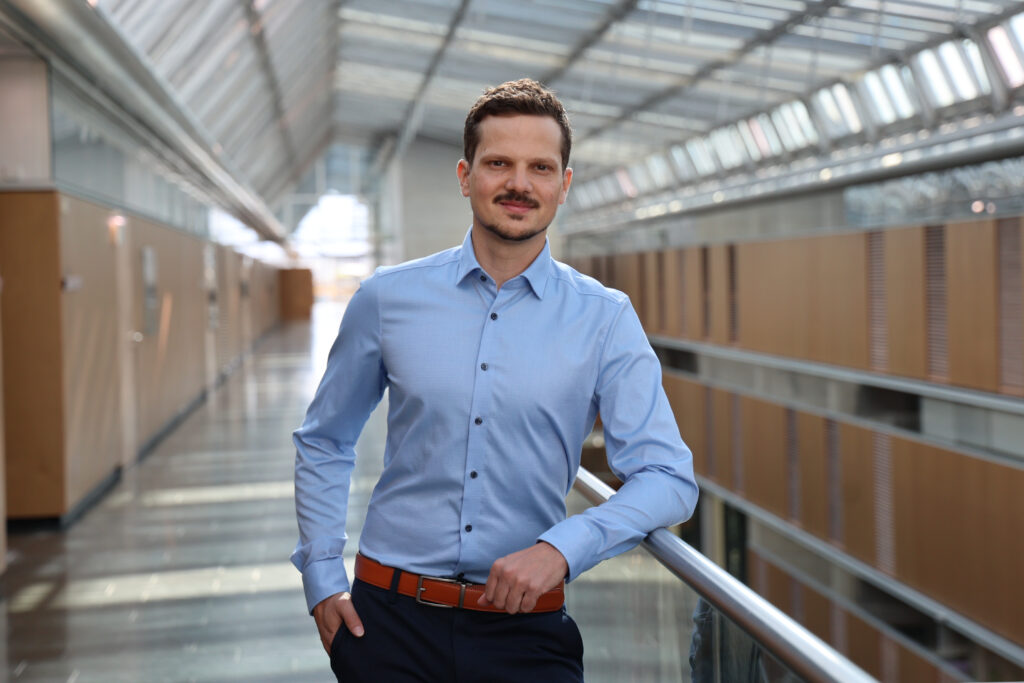
Simon has been awarded a prestigious Starting Grant by the European Research Council (ERC), the highest award for successful young scientists in Europe. We will receive 2.2 million euros of funding for our research on the interface between the classical and the quantum worlds.
See here for the official press release by the University of Innsbruck.
One spin, two paths: Building a Schrödinger‑cat with a levitated diamond
Where does the quantum world end and the classical world begin? We simply don’t know yet—that’s the frontier we want to explore. With our ERC Starting Grant project SpinCaT, we aim to push the boundary between these two worlds by creating macroscopic quantum states of motion in levitated nanodiamonds and using them to test wavefunction-collapse models. The core goal is to prepare a Schrödinger‑cat‑like spatial superposition—a particle in two places at once—and measure how long the coherence of this state survives under well-controlled conditions. The project targets unexplored regimes where prominent collapse models can be stringently constrained, while also opening avenues for quantum-enhanced sensing.
At its heart, the project uses a single quantum spin—a single nitrogen‑vacancy (NV) center—to steer the motion of an entire diamond crystal. Think of the spin as a transistor gate: a small, precisely controlled quantum setting that, in a strong magnetic‑field gradient, directs the particle’s trajectory. In a Stern–Gerlach–type configuration, distinct spin states feel distinct forces; if the spin is prepared in a superposition, the nanodiamond’s center‑of‑mass wavefunction splits accordingly, tracing two trajectories at the same time that can be read out with phase‑sensitive measurements—an explicit cat‑like signature at mesoscopic scales. “Cat‑like” here refers to Schrödinger’s famous thought experiment, where a cat is described as being in a superposition of „dead“ and „alive“ until observed.
To enable these tests, we will combine precise single‑spin control with low‑noise levitation and resonant, single‑shot spin readout, so that one well‑controlled spin becomes a tool for both state preparation and verification of non‑Gaussian mechanical states. The platform opens two concrete avenues: quantum‑enhanced inertial and magnetic sensing with macroscopic superpositions, and testable approaches to probing the quantum nature of gravity — one of today’s greatest scientific puzzles.